


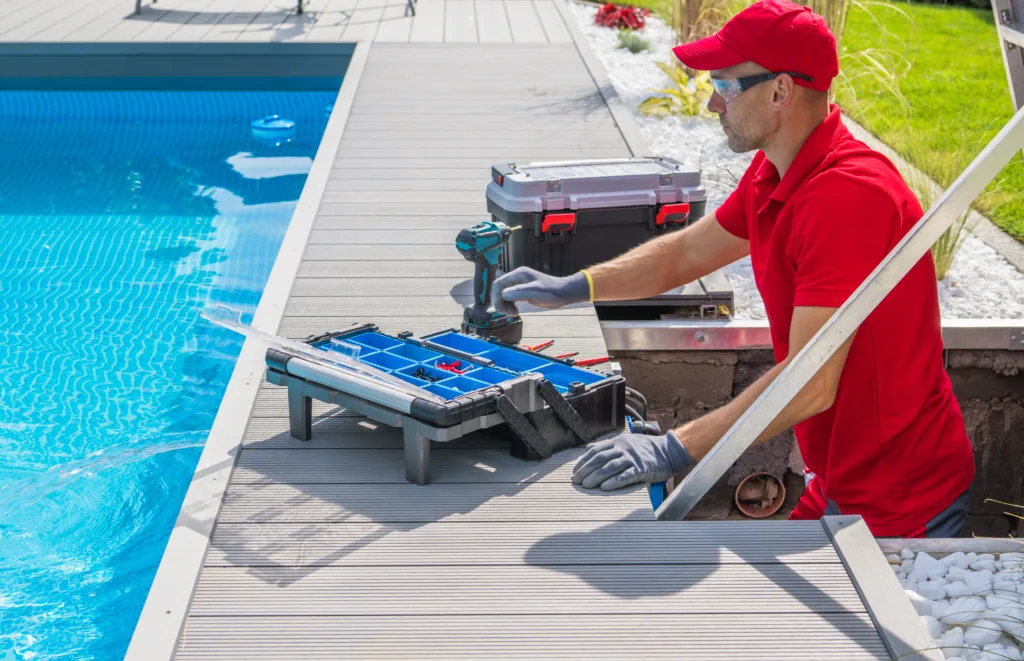
Short answer: most pool pump faults on the Costa Blanca start with something simple: a full strainer basket, a closed valve, a water level that has dropped below the skimmer or a sand filter that needs backwashing. Check those first, with the pump switched off at the breaker. If the pump hums but does not turn, drips from between the motor and the pump body, grinds, or trips the breaker, stop and call a technician: those point to a worn seal, bearings, a capacitor or an electrical fault. Caught early, a weeping seal costs far less to fix than a burnt-out motor. Our site visit is free and you get the repair price in writing before we start.
Why the pump matters more than any other part
The filtration pump runs for hours every day. A common rule, quoted by Repsol, is to filter for as many hours as the water temperature in °C divided by two, which means about 14 hours a day in August and 7 in January. Repsol puts the power of a household pool pump between 0.5 and 2 kW. On an 8×4 m pool with a 0.75 kW pump that adds up to about 2,700 kWh and roughly €550 a year, as we work out in how much it costs to run a pool in Spain.
A pump that struggles costs more to run and wears out faster. Repsol notes that a clogged filter forces the pump to push against extra resistance, which raises consumption and shortens the life of the equipment.
Warning signs and what they usually mean
| What you notice | Most likely cause | What to do |
|---|---|---|
| Weak return jets, little flow | Full strainer or skimmer basket, closed valve, dirty sand filter, low water level | Run the checks below |
| Bubbles in the strainer lid, pump sucks air | Lid O-ring not seated, or air entering on the suction side (a skimmer joint or a pipe) | Clean and refit the O-ring; if the bubbles stay, ask for a pressure test of the suction line |
| Rattling or hammering noise | Air or restricted suction, so the pump is starved of water | Check the water level, baskets and valves, then call if it continues |
| High-pitched whine or grinding | Worn motor bearings | Switch off and call; a bearing that fails can take the motor with it |
| Water dripping from between the motor and the pump body | Worn shaft seal | Call; a seal that “weeps” is the cheapest moment to replace it |
| Hums but the shaft does not turn | Jammed impeller or a failed capacitor | Switch off at the breaker and call; do not keep restarting it |
| Breaker trips, motor casing is very hot | Overload or an electrical fault | Leave it off and call |
This is a guide to the usual causes, not a diagnosis: the same symptom can have more than one cause, which is why we look at the pump and the circuit before quoting.
Five checks you can do yourself (pump switched off)
- Water level. It should sit around the middle of the skimmer opening. If it is lower, the pump pulls in air.
- Baskets. Empty the strainer basket on the pump and the baskets in the skimmers. Leaves and insects from the garden are the most common cause of weak flow.
- Valves. Check that the suction and return valves are open and set to filtration.
- Sand filter. Habitissimo recommends backwashing a sand filter at least once a week, and the sand is most often changed about once a year.
- Lid O-ring. Wipe it clean, check it is not cracked and refit the lid evenly.
Never open the motor or work on the wiring yourself, and never run the pump dry for more than a few seconds. If the checks do not solve it, the problem is not in the baskets.
Repair or replace?
We do not publish a single price for a pump, because the cause and the size of the pump decide it: a seal or a capacitor on a good pump is a small job, while a pump with worn bearings and a burnt winding is usually cheaper to replace than to rebuild. You get both figures in writing before anything starts, so you can compare.
If the pump is old and single-speed, replacement is also the moment to consider a variable-speed pump. Repsol calls it the upgrade with the best return, with savings of up to 80% against a fixed-speed pump. On the 8×4 m pool above, that moves the pump from about €550 a year to roughly €170 to €270, and the difference is what pays for the upgrade.
How to avoid the call-out
- Empty the baskets and backwash the filter on a routine, not when the flow has already dropped.
- Keep the water level right through summer, when evaporation drops it by several millimetres a day.
- Have the pump looked at once a year. Habitissimo puts routine maintenance of a private pool at around €60 a month; with a service visit a weeping seal, a filter that loses pressure or a level that falls faster than evaporation explains are found in March, not in July. See our pool maintenance service.
- If the level keeps falling while the pump runs normally, the pump is not the problem. Read how a pool leak is found without breaking the terrace.
Questions we get asked
Is it normal for the pump to be noisy?
A steady hum is normal. A rattle, a whine or a grinding noise is not: the first usually means the pump is starved of water, the others point to bearings.
Can I leave a dripping pump until the end of summer?
We would not. A weeping seal lets water reach the motor, and a motor that has been wetted is the expensive repair. It is also one of the cheapest faults to fix when it first appears.
How much does it cost to have you look at it?
The visit is free and carries no obligation. After it you get the scope, the materials and the price in writing, and if something changes on site you hear the new figure before the work is done.
Pump noisy, weak or dripping? Call +34 634 928 081 or send us the address. Autumn and winter are our quiet months, so the pool is ready before the season instead of during it. We answer in English, Spanish, Polish and Russian, Monday to Friday, 08:00 to 17:00.
